

Introduction: The Visual Edge in ICSE Biology
Why Diagrams Are Essential for ICSE Biology Success
2. Enhanced Conceptual Clarity
3. Effective Memory Retention (Visual Learning)
4. Presentation and Impression
The Master Toolkit: Essential Supplies for ICSE Diagram Practice
The Art of the Perfect Diagram: Step-by-Step Technique
2. Detailing and Defining Lines
3. The Labelling Protocol: The Most Important Step
4. Shading and Colour (Use with Caution)
High-Yield ICSE Biology Diagrams: Chapter-Wise Checklist
Unit 3: Human Anatomy and Physiology
B. Respiratory and Excretory Systems
C. Endocrine and Reproductive Systems
Unit 4: Population and Pollution
Common Mistakes to Avoid in Diagram Drawing
Practice Strategy: How to Master Diagrams Efficiently
1. Daily Drawing Habit (The “5-Minute Sketch”)
3. Self-Assessment and Peer Review
4. Integrate Diagrams with Theory
Conclusion: Drawing Your Way to a Biology Distinction
“Studying biology without diagrams is like trying to understand a city’s layout from a verbal description alone—confusing and incomplete, as visuals clarify complex structures and processes far better than words.”
Introduction: The Visual Edge in ICSE Biology
“In biology, nothing is more important than being able to visualize structures. A well-drawn diagram is worth a thousand words of description.” – Adapted from educational wisdom
ICSE Biology is a fascinating subject, but mastering it requires more than just rote memorization of concepts.
For students aiming for top scores in the Class 10 board examinations, the ability to accurately draw, label, and interpret biological diagrams is absolutely crucial.
Diagrams are not just an optional add-on; they are an integral component of the ICSE Biology paper, often carrying substantial weight (up to 15-20% of the total marks).
Biology diagrams are the backbone of ICSE examinations, often carrying significant weightage in both theory papers and practical assessments.
Whether you’re sketching the structure of a human heart or illustrating plant cell anatomy, the ability to draw accurate, well-labelled diagrams can be the difference between average and exceptional marks.
Guide’s Purpose: This comprehensive guide will break down the entire process,
- covering the importance of diagrams,
- specific tools and techniques,
- and a chapter-by-chapter list of high-yield diagrams for exam preparation.
Why Diagrams Are Essential for ICSE Biology Success
The Santiago Ramón y Cajal Story: When Artistic Diagrams Changed Neuroscience Forever
A Story to Inspire Your Biology Diagram Journey
Before we dive deeper into techniques, let me share a story that perfectly illustrates why mastering biological diagrams matters far beyond just scoring marks in ICSE exams.
In the late 1800s, a Spanish scientist named Santiago Ramón y Cajal was struggling to understand the mysterious structure of the nervous system. At that time, most scientists believed the brain was a continuous web of interconnected tissue. But Cajal had a unique advantage that his contemporaries didn’t—he was an exceptionally skilled artist.
As a young boy, Cajal loved drawing so much that his father, a surgeon, initially disapproved of his artistic pursuits, considering them a waste of time. Young Santiago would sketch landscapes, people, and anything that caught his eye. His father wanted him to focus on serious medical studies instead. Little did either of them know that this “distraction” would become Cajal’s greatest scientific asset.
When Cajal began studying neurons under a microscope, he didn’t just observe—he drew. Meticulously. Beautifully. Accurately. His hand-drawn diagrams of nerve cells were so precise and detailed that they revealed something revolutionary: neurons were individual cells, not a continuous network. His artistic training allowed him to see and represent subtle details that other scientists missed or couldn’t properly communicate.
His diagrams were so accurate that they’re still used in neuroscience textbooks today, more than a century later. In 1906, Cajal won the Nobel Prize in Physiology or Medicine, not despite his artistic skills, but largely because of them. His ability to create clear, precise biological diagrams allowed him to communicate complex discoveries in ways that words alone never could.
What This Means for You
Cajal’s story teaches us three crucial lessons relevant to your ICSE biology journey:
First, the diagrams you’re learning to draw aren’t just academic exercises—they’re a language of science. Just as Cajal used his drawings to communicate breakthrough discoveries, your diagrams in exams communicate your understanding to examiners. A well-drawn, properly labelled diagram speaks volumes about your comprehension of biological structures.
Second, the “boring” practice of drawing the same structures repeatedly isn’t meaningless repetition. Cajal drew thousands of neurons over his lifetime, and each drawing deepened his understanding. When you practice drawing the human heart for the tenth time, you’re not just memorizing shapes—you’re training your brain to understand spatial relationships, functional connections, and biological logic.
Third, attention to detail matters immensely. Cajal’s Nobel Prize-winning work succeeded because he drew exactly what he saw, with precision and care. Similarly, in your ICSE exams, those small details—the correct position of a valve in the heart, the precise number of chambers, the accurate shape of cell organelles—are what separate good marks from excellent ones.
The next time you sit down to practice a biology diagram, remember Santiago Ramón y Cajal. What seemed like a simple artistic skill became the foundation of modern neuroscience. Your careful practice of biology diagrams today is building skills that extend far beyond examinations—you’re learning to observe, represent accurately, and communicate scientifically.
As Cajal himself once said: “As long as our brain is a mystery, the universe, the reflection of the structure of the brain, will also be a mystery.” Your diagrams are your way of unravelling that mystery, one carefully drawn structure at a time.
Many students underestimate the importance of diagrams until the last moment. However, mastering them offers several key advantages:
1. Direct Mark Scoring
In the ICSE Biology paper, questions frequently require students to:
- Draw and label a specific biological structure (e.g., a neuron, a stoma).
- Identify a part of a given diagram.
- Explain a process using a flowchart or a simple sketch.
These questions are often straightforward, and a well-drawn, accurately labelled diagram can secure easy, full marks that text-based answers might miss.
2. Enhanced Conceptual Clarity
Drawing a diagram forces you to understand the spatial relationship and relative positioning of different parts of a biological structure.
This active engagement with the material deepens your understanding far better than passively reading about it.
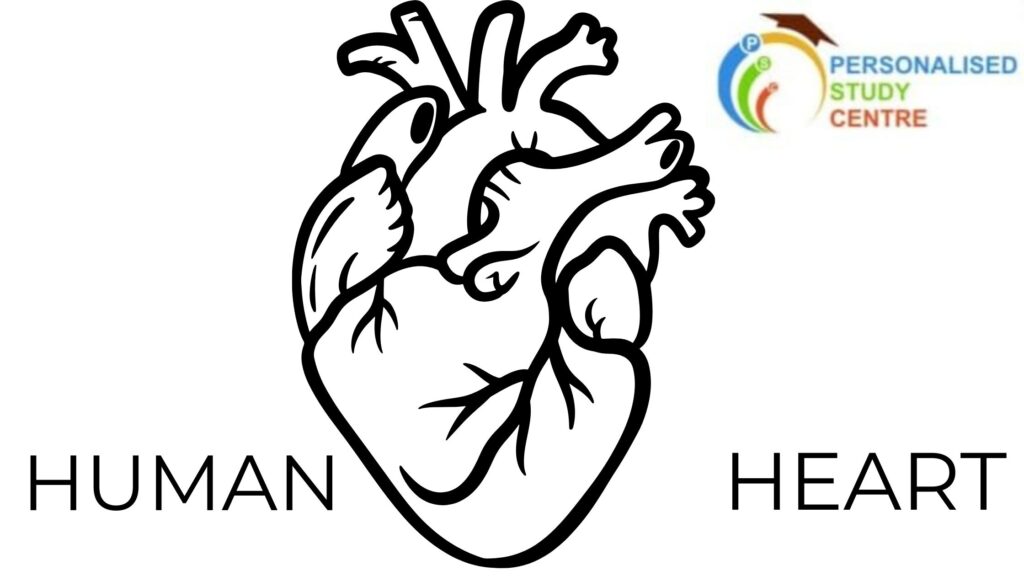
For example, drawing the human heart helps cement the path of blood circulation and the roles of the valves in a way text alone cannot.
3. Effective Memory Retention (Visual Learning)
“Memory is the residue of thought. When you understand why a structure looks the way it does, you’ll never forget how to draw it.” – Daniel Willingham, Cognitive Scientist
Humans are visual learners. A study of science education shows that visual aids, like diagrams, significantly improve long-term memory. When you practice drawing, you create a visual anchor for the textual information, making recall during the exam much easier.
4. Presentation and Impression
A neat, well-illustrated answer script stands out to the examiner. Including relevant, clean diagrams even when not explicitly asked for (for explanation purposes) demonstrates a thorough understanding and professionalism, which can positively influence overall marking.
The Master Toolkit: Essential Supplies for ICSE Diagram Practice
Before you start drawing, ensure you have the right tools. Quality supplies make a huge difference in the clarity and final appearance of your diagrams. To get free assistance, click here
| Item | Purpose | Key Feature |
|---|---|---|
| Pencils | Drawing and sketching | Sharp, well-sharpened HB or 2B for smooth lines. |
| Ruler/Scale | Drawing straight lines for labels and boundaries | Transparent, 15cm or 30cm, for accuracy. |
| Eraser | Correcting mistakes | High-quality, non-smudging (e.g., kneaded or plastic). |
| Geometry Box | Drawing circles, curves (e.g., eye, brain) | A compass and a Protractor are often needed. |
| Fine Liner Pens | Optional: for final outlining (Practice only!) | Black ink, 0.4mm or 0.5mm tip (Use only if permitted by school guidelines). |
| Practice Notebook | Dedicated space for diagram practice | Plain white pages (unruled) or graph paper. |
Pro Tip: Always use a well-sharpened pencil for the actual exam. Ink pens are generally discouraged for drawing biological diagrams unless specified.
An Indian Success Story to Inspire Your Journey
Before we explore advanced techniques, let me share a story from India’s own beloved
Dr. APJ Abdul Kalam beautifully illustrates why mastering diagrams and visual understanding matters in ways you might never expect
The Rameswaram Lesson: Dr. Kalam and the Power of the Biological Diagram
Before he was the Missile Man and the nation’s beloved President, Dr. APJ Abdul Kalam was a young student whose curiosity was profoundly shaped by his biology lessons. His journey from Rameswaram to Rashtrapati Bhavan offers a vital insight for every ICSE student: the simple act of drawing a biological diagram is the first step toward scientific mastery.
The pivotal moment came not in a classroom, but on the beach. Dr. Kalam’s science teacher, Siva Subramania Iyer, wanted to teach the students about aerodynamics and the secret of flight. Instead of reading dusty texts, Iyer took the class to the seashore and gave them a simple instruction: Observe the seagulls and sketch their movements.
Young Kalam spent hours sketching. He wasn’t drawing birds for art; he was drawing their mechanics. He meticulously noted the angles of their wings during a glide, the shift in their body structure for lift, and the precise design of their wings in relation to their function. His pencil and notebook became tools for scientific observation. His teacher emphasized that true scientific comprehension emerges only after one observes nature and translates that complex reality into a clear, simplified visual model.
Years later, when Dr. Kalam’s career shifted to the complex world of aerospace engineering and missile design, he often reflected on those foundational biology lessons. The principles he learned—that structure is intrinsically linked to function, that careful observation precedes good design, and that complex systems must be accurately represented on paper—became the guiding philosophy of his engineering approach. The Connection to Your ICSE Exams
Dr Kalam’s story resonates deeply with the ICSE curriculum, which champions comprehensive understanding over rote learning. When you are asked to draw the internal structure of a human heart or the cross-section of a leaf, the examiner is testing the same skills Kalam’s teacher nurtured:
- You must be an Observer: Like Kalam watching the seagulls, you must train yourself to see the detailed relationships between parts of a biological structure.
- You must be a Communicator: A perfectly drawn, correctly labelled diagram is your clearest statement of understanding. It communicates complex knowledge far more effectively than words.
- You must be an Analyst: Every line you draw should represent a function. Drawing the long, coiled small intestine should trigger the thought: This length provides maximum surface area for nutrient absorption. This functional connection is what makes the knowledge stick.
Dr Kalam reminds us: “Learning gives creativity, creativity leads to thinking, thinking provides knowledge, and knowledge makes you great.”
The precision you apply to a diagram of the nephron today is the same precision you will apply to complex problems tomorrow. Approach your biology diagrams with the dedication of a future president and scientist. You are not just practicing for an exam; you are developing the scientific mindset that will serve you throughout your life.
Dr. Kalam often told students: “A Dream is not that which you see while sleeping, it is something that does not let you sleep.” For ICSE students, your immediate dream might be scoring excellent marks in biology. But the skills you develop while mastering these diagrams—precision, attention to detail, scientific observation, and visual communication—are skills that will serve you throughout your academic and professional life, regardless of which field you ultimately choose.
The Art of the Perfect Diagram: Step-by-Step Technique
A perfect diagram isn’t just about artistic skill; it’s about following a structured technique that prioritizes clarity and accuracy.
1. Sketching and Outlining
- Light Hand: Start with a very light hand to sketch the overall shape and proportion of the structure. Do not press hard initially.
- Geometric Shapes: Break down complex structures into simple geometric shapes (e.g., a kidney is bean-shaped, a leaf section is often rectangular).
- Proportional Accuracy: Ensure that the parts are drawn in correct proportion to one another. For instance, the nucleus should be correctly sized relative to the cell.
2. Detailing and Defining Lines
- Darken and Refine: Once the sketch is satisfactory, go over the lines to make them darker and clearer.
- Focus on Key Structures: Only include the necessary details. Avoid drawing too many confusing microscopic elements unless the question specifically asks for them. Simplicity equals clarity.
3. The Labelling Protocol: The Most Important Step
This is where students often lose marks. Follow these rules religiously:
- Placement: All labels must be written neatly on one side of the diagram (preferably the right side).
- Label Lines (Leaders): Use a ruler to draw thin, straight, parallel lines (leader lines) from the labelled part to the label text. NEVER let the leader lines cross each other.
- Clarity: Write the names of the parts clearly and correctly. Spelling mistakes in labels cost marks.
- Title: Every diagram must have a clear, descriptive title written underneath it (e.g., Fig. 1. T.S. of a Dicot Leaf).
4. Shading and Colour (Use with Caution)
- Shading: Light stippling or minimal, uniform shading can be used to differentiate parts (e.g., cytoplasm vs. cell wall). Avoid heavy shading or colouring in the exam unless explicitly allowed.
- No Freehand Labels: Always use a ruler for label lines!
High-Yield ICSE Biology Diagrams: Chapter-Wise Checklist
The ICSE syllabus covers several units, each containing crucial diagrams. Focusing your practice on the following high-probability diagrams will maximise your preparation time.
Unit 1: Basic Biology
| Diagram | Key Focus Areas |
|---|---|
| Plant Cell & Animal Cell | Cell wall, nucleus, mitochondria, vacuole. |
| Mitosis (Stages) | Prophase, Metaphase (chromosome arrangement). |
| T.S. of a Chromosome | Chromatids, centromere, DNA thread. |
| Osmosis Setup | Thistle funnel, semi-permeable membrane. |
Unit 2: Plant Physiology
| Diagram | Key Focus Areas |
|---|---|
| T.S. of a Stoma | Guard cells, chloroplasts, stomatal pore. |
| L.S. of a Flower | Sepals, petals, stamen (anther, filament), carpel (stigma, style, ovary). |
| Structure of a Seed | Embryo, cotyledons, radicle, plumule (Dicot and Monocot). |
| Light/Dark Reaction Setup | Essential for understanding photosynthesis experiments. |
Unit 3: Human Anatomy and Physiology
This unit contains some of the most complex and high-scoring diagrams.
A. Circulatory System
- Structure of the Human Heart (L.S.): Atria, Ventricles, Vena Cavae, Aorta, Pulmonary Artery/Vein, Valves.
- Structure of a Neuron (Nerve Cell): Dendrites, Axon, Axon terminal, Myelin sheath, Node of Ranvier.
B. Respiratory and Excretory Systems
- Human Respiratory System: Trachea, Bronchi, Lungs, Alveoli (simplified).
- Structure of the Kidney/Nephron: Renal artery/vein, Bowman’s Capsule, Glomerulus, Convoluted tubules.
C. Endocrine and Reproductive Systems
- L.S. of a Tooth: Enamel, Dentin, Pulp Cavity.
- The Eye (L.S.): Cornea, Lens, Retina, Optic Nerve, Ciliary Body.
- The Ear (Structure): Outer, Middle, and Inner Ear components.
- Male and Female Reproductive Systems (Outline sketches).
Unit 4: Population and Pollution
- A Simple Food Chain/Food Web: Showing trophic levels.
- The Carbon Cycle (Flowchart Diagram): Key processes like Photosynthesis and Respiration.
Common Mistakes to Avoid in Diagram Drawing
Avoiding these pitfalls will significantly boost your score:
- Crossing Label Lines: Leader lines must never intersect. Keep them parallel and neat.
- No Ruler Used: Freehand label lines look messy and unprofessional. Always use a ruler.
- Missing Title: Failing to provide a clear, descriptive title is an automatic mark deduction.
- Incomplete/Incorrect Labelling: Only labelling 3 out of 5 requested parts, or mislabeling a part (e.g., calling an atrium a ventricle).
- Small Diagrams: Draw diagrams large enough (at least half a page) to accommodate clear labelling and detailing.
- Heavy Shading/Colouring: Stick to pencil outlines and minimal shading. Excess color wastes time and can obscure details.
Practice Strategy: How to Master Diagrams Efficiently
“Practice doesn’t make perfect. Perfect practice makes perfect. One diagram drawn with full attention is worth ten drawn mindlessly.” – Vince Lombardi (adapted for academic
Mastering diagrams requires dedicated practice, not just reading.
1. Daily Drawing Habit (The “5-Minute Sketch”)
Dedicate 15-20 minutes daily to draw 2-3 diagrams from the high-yield list. Start by copying from the textbook, then try reproducing it from memory. The goal is muscle memory.
2. Time Management Practice
Diagram questions are often timed. Practice drawing and labelling a complex diagram (like the Human Heart or Nephron) within 5-7 minutes. Speed and accuracy are equally important.
3. Self-Assessment and Peer Review
- Compare: After drawing, immediately compare your diagram and labels with the textbook. Mark, where did you go wrong?
- Key Detail Checklist: For each diagram, create a mental checklist of the top 5 key parts that must be labelled. Ensure these are always included.
- Seek Feedback: Ask your teacher or a high-scoring peer to critique your diagrams. Fresh eyes often spot labelling errors or proportionality issues.
4. Integrate Diagrams with Theory
When revising a topic (e.g., Excretion), draw the relevant diagram (Nephron) before you start reading the theory. This reinforces the visual memory and makes the textual explanation easier to grasp.

Conclusion: Drawing Your Way to a Biology Distinction
Mastering ICSE Biology diagrams is a key goal that distinguishes between good and excellent scores. By adopting the right tools, following a structured drawing technique, focusing on the high-yield structures listed above, and practicing consistently, you can turn diagram questions into easy, guaranteed marks.
Remember: Clarity, Accuracy, and Neat Labelling are the three pillars of a high-scoring Biology diagram. Start your practice today and draw your path to a distinction in your ICSE Biology board exam!